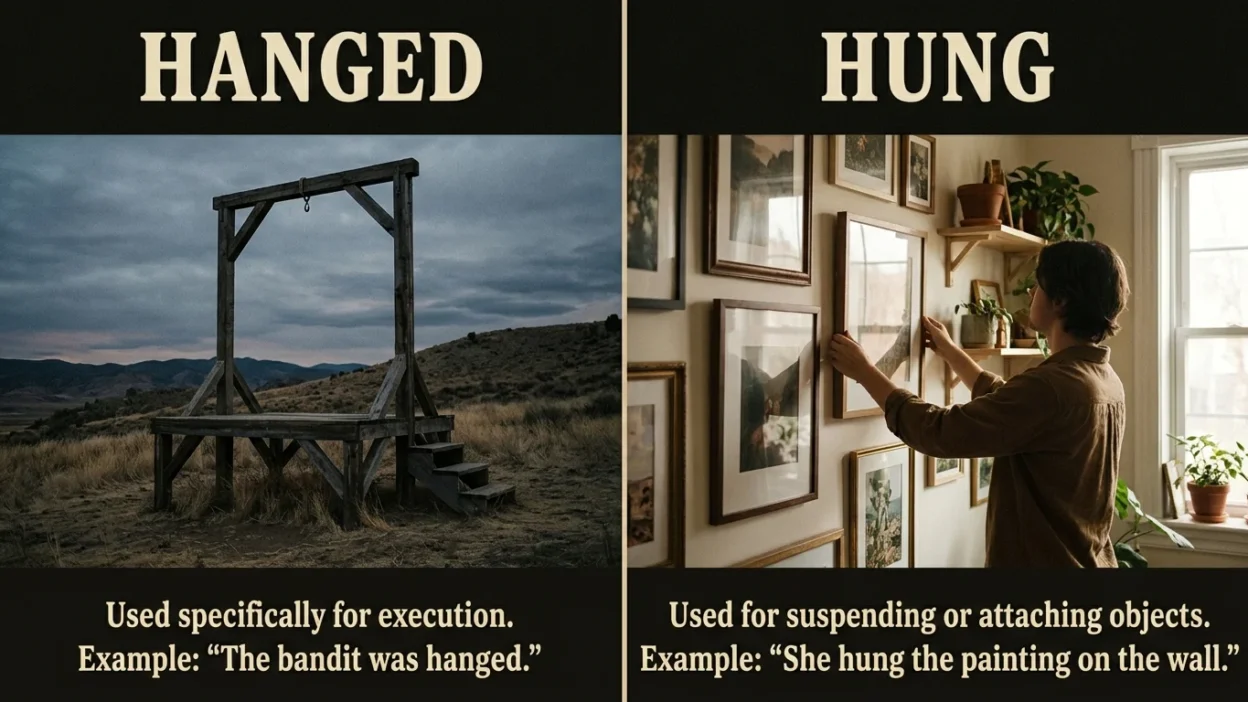
Have you ever wondered whether to write hanged or hung? Both words come from the verb hang, but they are not always used in the same situations. Choosing the correct word can be confusing for students, English learners, writers, and even native speakers. The good news is that the difference is simple once you understand the basic grammar rule.
The words hanged and hung are both past forms of hang, but they have different meanings and uses. Generally, hanged refers to execution by hanging a person, while hung describes placing or suspending something from a particular point. For example, you say, “The picture was hung on the wall,” but “The prisoner was hanged.” In this guide, you will learn their meanings, grammatical differences, correct usage, common mistakes, and practical examples to help you use both words confidently.
Quick Answer: Hanged vs. Hung
Hanged and hung are both past forms of the verb hang. However, they have different uses. Use hanged when referring to a person being executed by hanging. Use hung when talking about placing, suspending, or attaching something somewhere, such as a picture, coat, or decoration.
Why Do People Confuse Hanged and Hung?
People often confuse these words because they come from the same verb: hang.
In regular English grammar, past-tense and past-participle forms often follow predictable patterns. However, hang has two different forms depending on its meaning.
Here is the basic distinction:
- Hanged: Used for execution by hanging.
- Hung: Used for suspending or attaching something.
Both words are grammatically correct, but they cannot always replace each other.
For example:
- Correct: The painting was hung in the living room.
- Correct: The criminal was hanged for his crimes.
Understanding the meaning of the sentence helps you select the correct word.
What Does Hanged Mean?
Hanged is the past tense and past participle of hang when referring specifically to execution by hanging.
It describes a historical or legal method of execution in which a person is put to death by hanging.
Examples of Hanged
- The prisoner was hanged many years ago.
- The criminal was hanged after his trial.
- The historical document explained why the man was hanged.
- The soldier was hanged during the war.
- The book describes how prisoners were hanged in the past.
When Should You Use Hanged?
Use hanged when the sentence refers to:
- Execution by hanging.
- Historical executions.
- A person being put to death through hanging.
- Events involving this specific form of execution.
Remember that hanged has a very specific meaning. It is not the normal past tense for everyday situations involving hanging objects.
What Does Hung Mean?
Hung is the past tense and past participle of hang when referring to suspending, attaching, or placing something so that it is supported from above.
It is commonly used in everyday English.
For example, when you put a picture on a wall, place a coat on a hook, or decorate a room with lights, you use hung.
Examples of Hung
- She hung the picture on the wall.
- He hung his jacket behind the door.
- They hung colorful lights around the house.
- I hung my clothes in the wardrobe.
- The teacher hung a map in the classroom.
When Should You Use Hung?
Use hung when describing:
- Pictures placed on walls.
- Clothes placed on hooks.
- Decorations attached to ceilings or walls.
- Curtains installed above windows.
- Objects suspended from something.
- A person hanging up a phone.
For example:
- She hung the curtains yesterday.
- He hung up the phone.
- We hung decorations for the party.
In these examples, hung describes ordinary actions rather than execution.
Hanged vs. Hung: Comparison Table
| Feature | Hanged | Hung |
|---|---|---|
| Base verb | Hang | Hang |
| Past tense | Hanged | Hung |
| Past participle | Hanged | Hung |
| Main meaning | Executed by hanging | Suspended or attached |
| Common usage | Historical or legal contexts | Everyday situations |
| Example | He was hanged. | He hung the picture. |
The main difference is the meaning of the action, not the subject’s gender or whether the sentence is past or present.
When to Use Hanged vs. Hung
Choosing between these words becomes easier when you focus on what the sentence describes.
Use Hanged for Execution
When describing a person who was executed by hanging, use hanged.
Examples:
- The prisoner was hanged.
- The historical figure was hanged in the eighteenth century.
- The criminal was hanged after being convicted.
Use Hung for Everyday Actions
When describing something being suspended or attached, use hung.
Examples:
- She hung the picture.
- He hung his coat.
- They hung the decorations.
Use Hung for Hanging Up a Phone
The expression hang up also uses hung in the past tense.
Examples:
- She hung up the phone.
- He hung up before I could answer.
- I hung up after finishing the conversation.
Use Hung for Expressions and Descriptions
Some common English expressions also use hung.
Examples:
- The curtains were hung beautifully.
- His head hung low.
- The clothes were hung outside to dry.
15 Examples of Hanged vs. Hung in Sentences
Here are 15 practical examples to help you understand the difference.
- She hung the family photograph in the hallway.
- The prisoner was hanged many years ago.
- He hung his backpack on the chair.
- They hung colorful balloons around the room.
- The criminal was hanged according to the historical account.
- My mother hung the curtains in the bedroom.
- I hung my wet clothes outside to dry.
- The teacher hung a new chart on the classroom wall.
- The historical novel described how the prisoner was hanged.
- She hung her favorite painting above the sofa.
- He hung his uniform behind the door.
- The decorations were hung before the celebration.
- The old photograph was hung in a wooden frame.
- The soldier was hanged during the historical conflict.
- I hung up the phone after our conversation.
These examples show that the correct choice depends on the intended meaning.
Common Mistakes When Using Hanged and Hung
Even experienced English speakers sometimes mix up these words. Here are some mistakes to avoid.
Mistake 1: Using Hung for Execution
Incorrect: The prisoner was hung.
Correct: The prisoner was hanged.
When referring to execution by hanging, use hanged.
Mistake 2: Using Hanged for Pictures
Incorrect: She hanged the picture on the wall.
Correct: She hung the picture on the wall.
A picture is suspended or attached, so hung is correct.
Mistake 3: Thinking Hanged Is Always Wrong
Some learners believe that hanged is not a real English word.
That is incorrect. It is the correct past form when referring to execution by hanging.
Mistake 4: Thinking Hung Is Only Used for Objects
Hung can also describe people or body parts in ordinary situations.
For example:
- His head hung down.
- She hung up the phone.
- The child hung onto the railing.
Mistake 5: Using Both Words Interchangeably
Although both words come from hang, they have different meanings in standard usage.
Always consider the action before choosing one.
Easy Memory Trick: How to Remember Hanged vs. Hung
Here is a simple trick to remember the difference:
- Hanged = Execution
- Hung = Everything Else in the Ordinary Sense of Suspending
Think of the word hung whenever you imagine a picture, coat, curtain, or decoration being suspended.
Think of hanged when you read about historical execution.
A quick example:
- Picture on the wall = Hung.
- Person executed by hanging = Hanged.
This simple memory trick can help you avoid common grammar mistakes.
Hanged vs. Hung in American and British English
The distinction between hanged and hung is generally the same in American and British English.
Both varieties use:
- Hanged for execution by hanging.
- Hung for ordinary suspension or attachment.
There is no major difference between American and British English regarding this particular grammar rule.
For example:
- American English: She hung the picture.
- British English: She hung the picture.
Both are correct.
Similarly:
- American English: The prisoner was hanged.
- British English: The prisoner was hanged.
The spelling and grammatical usage remain the same in both varieties.
Similar Words Related to Hanged and Hung
Understanding related words can improve your English vocabulary and grammar.
| Word | Meaning | Example |
|---|---|---|
| Hang | To suspend something | Hang your coat here. |
| Hanging | The act of suspending something | The picture is hanging on the wall. |
| Suspended | Supported from above | The lamp was suspended from the ceiling. |
| Attached | Connected or fixed to something | The sign was attached to the wall. |
| Hanged | Executed by hanging | The prisoner was hanged. |
| Hung | Suspended or placed | She hung her dress. |
These words are related in meaning, but they are not always interchangeable.
Final Verdict: Hanged or Hung?
Both hanged and hung are correct English words, but they serve different purposes.
Use hanged when talking about a person being executed by hanging. Use hung when describing something suspended, attached, or placed somewhere.
For everyday English, hung is the form you will use most often.
Remember the simple rule: execution means hanged, while ordinary suspension means hung.
FAQs:
1. Is it hanged or hung?
Both are correct, but their meanings are different. Hanged refers to execution by hanging, while hung describes ordinary suspension or attachment.
2. Is hanged a real English word?
Yes. Hanged is the correct past tense and past participle of hang when referring to execution by hanging.
3. Should I say the picture was hanged or hung?
You should say, “The picture was hung.” Use hung because the picture is suspended on a wall.
4. Why do people say hanged instead of hung?
People use hanged when referring specifically to execution by hanging. It is a special grammatical form of the verb hang.
5. Is hung the past tense of hang?
Yes. Hung is the past tense and past participle of hang when describing ordinary suspension, attachment, or similar actions.
6. Can I use hanged for clothes?
No. In standard English, use hung when describing clothes placed on a hook, hanger, or washing line.
Correct: I hung my clothes in the wardrobe.
7. Do American and British English use hanged and hung differently?
No. Both American and British English generally follow the same rule: hanged refers to execution, while hung refers to ordinary suspension.
Remember This
- Hanged: Used for execution by hanging.
- Hung: Used for suspending or attaching something.
- Picture: Hung on the wall.
- Clothes: Hung in the wardrobe.
- Phone: Hung up.
- Execution: Hanged.
The easiest way to remember the difference is that hanged has a specific execution-related meaning, while hung is used for everyday situations.
Conclusion
Understanding the difference between hanged and hung is easier when you remember that both words are past forms of the verb hang, but their meanings are different. Use hanged when discussing execution by hanging and hung when talking about pictures, clothes, curtains, decorations, and other suspended objects.
With these simple rules and examples, you can choose the correct word in everyday conversations, school assignments, and professional writing. Remember: execution means hanged, and ordinary suspension means hung.

James William is a passionate technology writer and programming enthusiast at DreamTMyst. He simplifies coding concepts, software tutorials, and developer resources, helping beginners and professionals learn practical programming skills through clear, engaging, and easy-to-follow content.